
Cepheid-Logo
Informationen anfordern
Standort / Sprache

{{headingText}}

{{paragraphText}}

{{continueBtnLabel}}

{{initials}}

Main Menu
Standort / Sprache

{{headingText}}

{{paragraphText}}

{{continueBtnLabel}}

Informationen anfordern

Informationen anfordern

Xpert® Xpress GBS

GBS computer generated depiction.

Zwei Zielsequenzen für S. agalactiae (DNA) Serotypen I-X und Nicht-Beta-Hämolytikum in 30–42 Minuten

Der Bedarf

an ill woman listens to a physician
Gruppe-B-Streptokokken (GBS) sind weiterhin eine der Hauptursachen für eine Neugeborenen-Sepsis. Rates of maternal colonization have not changed, but universal antenatal screening at 35–37 weeks along with the use of intrapartum antibiotic prophylaxis (IAP) has resulted in a decrease of early-onset disease.1
Challenges remain, including:
  • Risiko einer Änderung des GBS-Kolonisationsstatus nach dem Screening in den Schwangerschaftswochen 35–372.3
  • Some women with unknown GBS status presenting at Labor and Delivery unit4.5
  • Aufgrund der risikobasierten IAP werden 65–85 % der GBS-negativen Frauen mit Antibiotika behandelt6

1 Wicker E, et al. Group B streptococci: declining incidence in infants in Germany. Pediatr Infect Dis J. 2019 Mai;38(5):516–9.
2 Helmig R, et al. Diagnostic accuracy of polymerase chain reaction for intrapartum detection of Group B Streptococcus colonization. Acta Obstet Gynecol Scand. 2017
Sep;96(9):1070-1074.
3 Melin P. Neonatal group B streptococcal disease: from pathogenesis to preventive strategies. Clin Microbiol Infect. 2011 Sep;17(9):1294-303.
4 Di Renzo et al. Intrapartum GBS screening and antibiotic prophylaxis: a European consensus conference. J Maternal Fetal Neonatal Med. 2014:1-17. Verfügbar unter: https://pubmed.
ncbi.nlm.nih.gov/25162923
5 ASM, March 2020, Guidelines for the Detection and Identification of Group B Streptococcus - Revised Guidelines from CDC, 2020
6 Saari A, et al. Antibiotic exposure in infancy and risk of being overweight in the first 24 months of life. Pediatrics. 2015 Apr;135(4):617–626.

Die Lösung

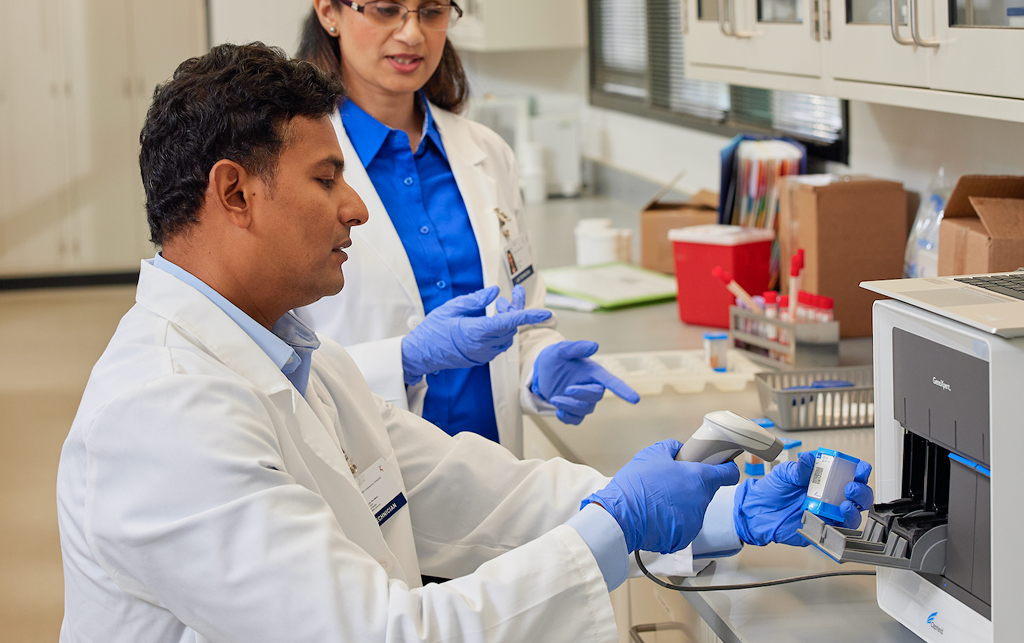
a male and a female researchers scanning cepheid test cartridges
  • The Xpert Xpress GBS test is a qualitative in vitrodiagnostic test intended for the detection of DNA from Group B Streptococcus (GBS). The test is performed usinga dual vaginal/rectal swab specimen collected from pregnant females during antepartum or intrapartum.
  • The Xpert Xpress GBS test is intended to aid in the diagnosis of GBS colonization to identify candidates for antibiotic prophylaxis.

Der Vorteil

a smiling female doctor attends an elderly woman
  • Identify GBS colonization status at the right time, at the time of labor (intrapartum).4
  • Identifying more women with GBS at the time of delivery and providing them with timely Intrapartum AntibioticProphylaxis (IAP) may result in a reduction of early-onset GBS disease in neonates.7
  • Fast and easy-to-interpret results enable adequate IAP delivered to mothers with unknown status, which may resultin less impact on the newborn intestinal flora.8.9
4 Di Renzo et al. Intrapartum GBS screening and antibiotic prophylaxis: a European consensus conference. J Maternal Fetal Neonatal Med. 2014:1-17. Verfügbar unter: https://pubmed.
ncbi.nlm.nih.gov/25162923
7 El Helali et al. Diagnostic Accuracy of a Rapid Real-Time Polymerase Chain Reaction Assay for Universal Intrapartum Group B Streptococcus Screening. Clin Infect Dis. (2009) 49 (3):
417-423.
8 Björklund V, et al. Replacing risk-based early-onset-disease prevention with intrapartum group B streptococcus PCR testing. J Matern Fetal Neonatal Med. 2017 Feb;30(3):368-373
9 Zimmermann P, et al. Effect of intrapartum antibiotics on the intestinal microbiota of infants: a systematic review. Arch Dis Child Fetal Neonatal Ed. 2020 Mär;105(2):201–8

CE 2797

Bessere Ergebnisse erzielen

Informationen anfordern
Powered by Translations.com GlobalLink Web SoftwarePowered by GlobalLink Web